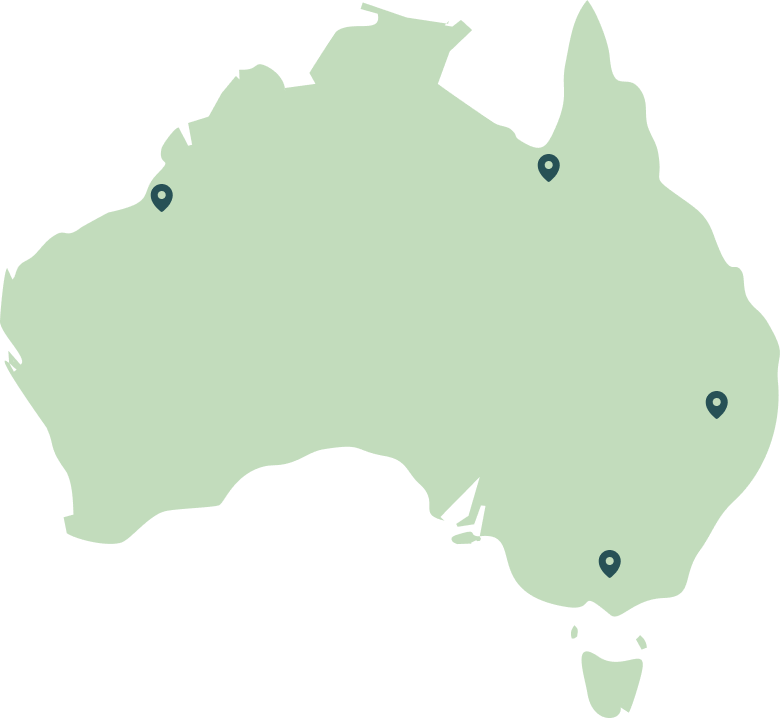
Australia’s low carbon liquid fuel (LCLF) industry is taking shape across the country, from projects already producing fuel to those in early feasibility. Use the filters to explore by project type and phase, and select a project to learn more.
Biodiesel production facility at Barnawartha in north-east Victoria, operating since 2008 and run by Just Biodiesel, with ISCC certification since 2019. The BDI-designed plant has a capacity of 60 ML/year and can run on tallow, used cooking oil and vegetable oils including canola oil. In 2026 about 500 tonnes of its tallow-based biodiesel was exported to Singapore by HAMR Energy for a BHP and Global Centre for Maritime Decarbonisation (GCMD) pilot, blended 50:50 with used cooking oil biodiesel as a B100 marine fuel.
Prescribed project on Ampol’s existing diesel hydrotreater at the Lytton refinery to enable co-processing of biogenic feedstocks (tallow and canola oil) with conventional diesel to produce renewable diesel. The facility will be capable of producing 15 to 20 million litres of renewable diesel per year.
SAF Oilseed Crushing Facility Pre-Deployment Study
Feedstock supply
Status
Pre-FEED
Sydney, New South Wales (study lead)
Capacity
330,000 tonnes/year
Two-stage study (pre-front-end engineering design then FEED) for an oilseed-crushing facility to produce canola oil as feedstock for downstream SAF production. Targets a minimum of 330,000 tonnes per annum of canola oil. GrainCorp is separately investigating a greenfield crushing facility of up to 1 million tonnes per year of canola.
Bundaberg region / Isis Central Sugar Mill, Queensland
Capacity
About 60 ML/year
Pre-FEED/FEED program for a proposed Bundaberg biorefinery converting ~150 kt/y sugarcane residues into ~60 ML/y of low carbon liquid fuels – of which ~40 ML/y could be SAF, with the balance renewable diesel, naphtha and very low sulphur marine fuel.
Pinkenba Terminal and Brisbane Airport, Queensland
Capacity
3.3 million
Reconditioned 3.3 million litre storage tank and distribution infrastructure at Viva Energy’s Pinkenba Terminal enabling blended SAF supply to Brisbane Airport through the existing pipeline, together with a book-and-claim system. The refurbished tank was officially opened in 2026 and the trial concludes in early 2027. Partners include Brisbane Airport Corporation and Virgin Australia.
Proposed commercial-scale facility gasifying and gas-fermenting waste to ethanol and converting it via alcohol-to-jet (ATJ), using the LanzaTech and LanzaJet CirculAir platform. Targets about 102 ML/year SAF and 12 ML/year renewable diesel. Equity investment from Boeing confirmed August 2024, with $760,000 in Queensland Government feasibility support.
Two-stage chain across Victoria and South Australia. At Portland, around 600,000 tonnes a year of Green Triangle plantation forestry residues plus renewable hydrogen produce about 300,000 tonnes of low carbon methanol, using thyssenkrupp Uhde’s PRENFLO gasification and uhde green methanol technologies. That methanol is converted at Gillman into around 140 million litres of SAF a year, plus renewable diesel, using Honeywell UOP technology, or can be sold directly as shipping fuel. Supply agreements with OneFortyOne and other Green Triangle forestry firms cover more than 100% of required input. Pre-FEED at Portland completed August 2025.
Dedicated SAF blending terminal co-located at Toowoomba Wellcamp Airport, operated by Wagner Sustainable Fuels with Boeing and Singapore-based FlyORO providing modular AlphaLite blending technology. Reported as Australia’s first dedicated SAF blending terminal, commencing operations on 15 October 2025. Wagner is also reported as Australia’s first RSB-certified SAF company.
Co-processing of bio-feedstocks such as used cooking oil and soft-plastics pyrolysis oil alongside conventional refinery streams at Viva Energy’s Geelong Refinery, one of Australia’s two remaining refineries. The refinery achieved ISCC+ certification for co-processed renewable diesel and circular polypropylene in February 2026, and the Victorian Government is co-funding a feasibility study to expand renewable diesel processing. The first co-processing phase targets about 50 ML/year of a 3% renewable diesel blend from 2026.
Shoalhaven Starches, Nowra / Bomaderry, New South Wales
Capacity
About 300 ML/year
Integrated ethanol production at Manildra’s Shoalhaven Starches site at Bomaderry, near Nowra. Maximum capacity of about 300 ML/year across fuel-grade and beverage-grade ethanol. Reported as Australia’s largest ethanol producer and RSB-certified sustainable since 2012.
Long-running ethanol distillery (commissioned 1927) producing about 60 ML/year of bioethanol from around 220,000 tonnes per year of molasses sourced from Burdekin to Sarina sugar mills. About two-thirds is sold to the Australian fuel market for E10 and E85 blends, with the balance industrial-grade.
First-of-a-kind project accelerator, publicly launched as the Green Fuels Accelerator in June 2026, providing targeted support to early-stage, post-feasibility LCLF developers and technology providers to improve investment readiness. Seven participants named: Licella, Wagner Sustainable Fuels, Renewable Developments Australia, Renergi, Wildfire Energy, Mercurius Biorefining and Ethanol Technologies (Ethtec). Runs from April 2026 to March 2027.
Pilot plant demonstrating Ethtec’s approach to producing cellulosic ethanol and other renewable chemicals from non-food lignocellulosic biomass such as sugarcane bagasse, crop stubbles and forest material. Expected ethanol production capacity of about 270,000 litres per annum, intended as a scalable demonstration facility and research and development centre to support commercial-scale cellulosic ethanol production. Project runs to December 2026.
Second Jet Zero Australia biorefinery development, proposed for Yarwun near Gladstone, as a 50:50 joint venture with Apeiron Bioenergy. Targets approximately 400 ML/year of SAF and renewable diesel via the HEFA pathway, with the flexibility to swing between maximum aviation fuel production and a co-production mix supplying up to 320 ML/year of renewable diesel for the mining, marine, heavy transport and defence sectors. A feasibility study supported by the Australian Department of Foreign Affairs and Trade and Enterprise Singapore found a strong technical and commercial case. Jet Zero has executed a letter of intent with Gladstone Ports Corporation to integrate the project into existing port infrastructure and is finalising a land deal with Economic Development Queensland for a site in the Gladstone State Development Area.
Bulwer Island (former refinery site), Brisbane, Queensland
Capacity
Up to 30,000 tonnes/year
Waste-to-fuels hub on the former Bulwer Island refinery site, using Wildfire Energy’s Moving Injection Horizontal Gasification (MIHG) technology. The reference plant would process up to 30,000 tonnes of residual waste per year, with an initial phase producing bio-syngas for about 1.4 MW of power and later phases producing low carbon methanol and SAF. ARENA is funding a pilot integrating MIHG with methanol synthesis.
Energreen oilseed processing and pongamia plantation
Feedstock supply
Status
EPC
Yamala (Central Queensland Inland Port) and surrounding Emerald district, Queensland
Capacity
70,000 tonnes/year
Multi-seed crushing and processing facility at Yamala in the Central Queensland Inland Port near Emerald, with capacity to process 70,000 tonnes a year of oilseeds for both edible oils and biofuel feedstock, and a longer-term focus on pongamia oil as a SAF feedstock. A joint venture with Nippon Steel Trading, Green Biotechnology Solutions, is establishing a large-scale pongamia plantation near Emerald, with an initial 16,000 trees planted in 2026.
Former Burnie Paper Mill site, South Burnie, Tasmania
Capacity
About 208,000 tonnes/year
Commercial e-fuels facility proposed for the former Burnie Paper Mill site in South Burnie, designed to produce about 208,000 tonnes per annum of e-methanol using renewable hydrogen from electrolysis combined with biogenic carbon dioxide from sustainably sourced biomass. The project was relocated from Hampshire in September 2025 to gain deepwater port access and modularisation benefits. Pre-front-end engineering design was completed in 2025 and a Notice of Intent has been lodged with the Tasmanian EPA.
Bell Bay (former Bell Bay Power Station site), northern Tasmania
Capacity
Up to 360,000 tonnes/year
Renewable hydrogen and green methanol facility at the Bell Bay Advanced Manufacturing Zone, combining a large-scale water electrolysis plant with biomass gasification of certified plantation forestry residues to produce up to 360,000 tonnes per annum of green methanol, targeted primarily at the maritime fuel market. Worley was engaged for front-end engineering design in January 2024, with Johnson Matthey supplying methanol synthesis technology, SunGas Renewables the biomass gasification technology and thyssenkrupp nucera the electrolysers. Named provisional proponent for the Tasmanian Green Hydrogen Hub in May 2025.

 Capacity60 ML/year